
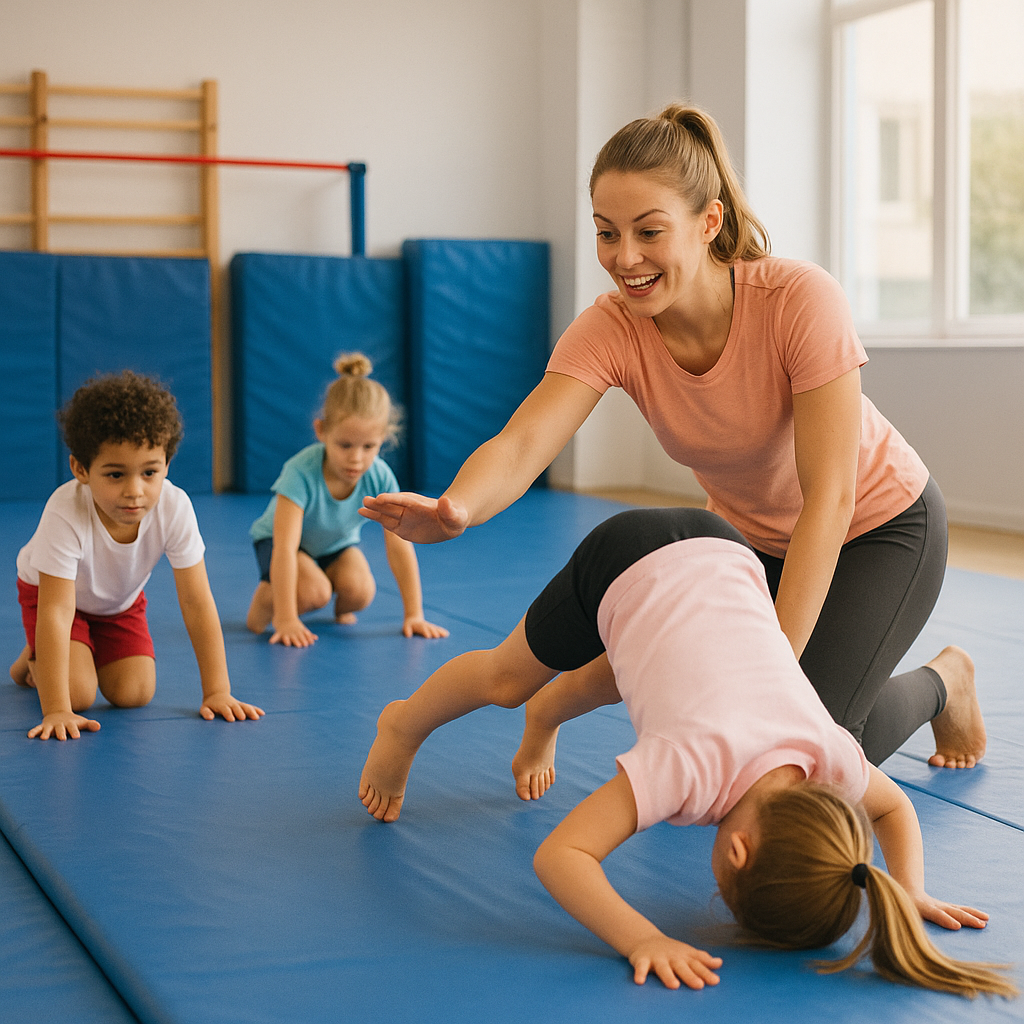
Structured tumbling and acrobatics classes provide young athletes with foundational physical and mental abilities that extend far beyond the mat, shaping confident, resilient, and well-rounded individuals.
Physical Strength and Core Stability Development
Structured tumbling classes and kids acrobatics training offer systematic development of physical strength that begins with foundational movements and progresses through measurable milestones. Young athletes ages 2–18 build functional muscle groups through age-appropriate drills that engage the entire body. From simple forward rolls to advanced handstands and walkovers, each skill requires coordinated muscle engagement that strengthens the legs, arms, back, and shoulders in ways that support healthy growth patterns.
Core stability forms the foundation of gymnastics fundamentals for kids and serves as the anchor for every tumbling skill. Structured classes emphasize proper hollow body positioning, plank variations, and dynamic core exercises that teach children to control their bodies through space. This development translates directly into improved posture, balance during everyday activities, and reduced injury risk in other sports and physical pursuits.
Parents often observe noticeable improvements in their child's physical capabilities within weeks of beginning kids tumbling and acrobatics classes. Children demonstrate increased stamina during play, better control when climbing or jumping, and enhanced coordination in activities ranging from playground games to organized sports. These benefits of tumbling for children extend well beyond the training facility, supporting overall child physical development and establishing healthy movement patterns that can last a lifetime.
Body Awareness and Spatial Intelligence
Body awareness represents one of the most valuable benefits of tumbling for children, as structured tumbling classes systematically teach young athletes to understand where their bodies are in space at all times. Through progressive drills and skill sequences, children learn to track their limbs during rotations, identify their center of gravity during inversions, and adjust their positioning mid-movement. This proprioceptive development begins with basic shapes and positions, then advances to complex aerial awareness during flips and twists.
Spatial intelligence develops naturally through kids acrobatics training as students learn to navigate the training environment safely and efficiently. Children practice judging distances before executing runs and tumbling passes, calculating the space needed for specific skills, and adjusting their movements based on available room. Instructors guide students through visualization techniques and spotting methods that enhance their ability to mentally map movement sequences before physical execution.
These cognitive skills transfer meaningfully into academic and everyday contexts. Parents report that children enrolled in structured tumbling classes demonstrate improved focus during homework, better estimation skills in math, and enhanced problem-solving abilities. The mental processing required to execute a cartwheel or back handspring—planning the approach, controlling the body through multiple phases, and landing with precision—builds neural pathways that support learning across all domains of child physical development.
Confidence and Mental Resilience Through Progressive Achievement
Structured tumbling classes create natural opportunities for building confidence through incremental skill mastery. Unlike unstructured play, kids tumbling and acrobatics classes follow carefully designed progressions that break complex skills into achievable steps. When a child masters a bridge, then a bridge kickover, then eventually a back walkover, they experience tangible proof of their growing capabilities. Each progression marker validates their effort and persistence, creating a foundation of self-belief that extends into other challenging areas of life.
Mental resilience develops organically when young athletes encounter and overcome the inevitable setbacks that accompany skill acquisition. A child attempting a round-off back handspring may require dozens of practice sessions before achieving consistent success. Through this process, they learn that temporary failure does not define their potential, that consistent effort produces results, and that perseverance through difficulty leads to breakthrough moments. Certified instructors provide constructive feedback and encouragement that reframes challenges as opportunities for growth rather than indicators of inadequacy.
The benefits of tumbling for children include the development of healthy coping mechanisms for performance pressure and self-doubt. As students prepare for skill evaluations, demonstrations, or performances, they learn to manage nervousness through breathing techniques, positive self-talk, and mental rehearsal. Parents consistently observe that children who participate in kids acrobatics training demonstrate greater willingness to attempt new activities, increased tolerance for discomfort during learning phases, and improved emotional regulation when facing academic or social challenges outside the training environment.
Discipline and Focus in Structured Training Environments
Structured tumbling classes establish clear expectations for behavior, attention, and effort that teach children the value of discipline in achieving goals. From the moment students enter the training space, they learn to follow established routines—proper warm-up sequences, respectful listening during instruction, and adherence to safety protocols. This structure provides predictability that helps young athletes understand the connection between following guidelines and achieving desired outcomes. Kids tumbling and acrobatics classes emphasize that gymnastics fundamentals for kids require consistent practice and attention to detail, lessons that transfer directly to academic settings and future professional environments.
Focus development represents one of the most significant benefits of tumbling for children in our increasingly distracted world. Executing a back handspring or aerial cartwheel demands complete mental presence—there is no room for wandering thoughts when controlling the body through complex movements. Instructors guide students through concentration exercises and mindfulness techniques that enhance their ability to sustain attention during challenging skill work. Over time, children develop the capacity to block out distractions, maintain focus during extended practice sessions, and apply full mental resources to the task at hand.
Parents frequently report that child physical development programs like kids acrobatics training produce noticeable improvements in behavior and performance across multiple life areas. Teachers observe better classroom focus, homework completion improves, and children demonstrate enhanced ability to follow multi-step directions. The discipline cultivated through structured tumbling classes—arriving on time, wearing appropriate attire, respecting instructors and peers, and maintaining effort through fatigue—establishes habits and mindsets that support success in academic, athletic, and personal pursuits throughout childhood and beyond.
Teamwork and Social Connection Among Young Athletes
Kids tumbling and acrobatics classes create natural opportunities for peer connection and collaborative learning that extend beyond individual skill development. While tumbling is often perceived as an individual pursuit, structured classes incorporate partner drills, group warm-ups, and team-building activities that require communication, cooperation, and mutual support. Young athletes learn to spot for one another during skill attempts, provide encouragement during challenging progressions, and celebrate teammates' achievements alongside their own. These interactions build social competencies that support healthy relationship formation throughout childhood and adolescence.
The social benefits of tumbling for children include exposure to diverse peer groups united by common goals and interests. Students ranging from preschoolers to teenagers work alongside others who share their passion for gymnastics fundamentals for kids, creating bonds that often extend beyond class time. Structured tumbling classes foster an environment where students cheer for one another's successes, offer comfort during setbacks, and develop genuine friendships based on shared experiences. This sense of belonging and community connection supports child physical development by creating positive associations with physical activity and healthy lifestyle choices.
Kids acrobatics training also teaches valuable lessons about respectful competition and collaborative improvement. Students learn to appreciate their own progress without comparing themselves negatively to peers, to seek help when struggling with specific skills, and to share strategies that have helped them overcome challenges. Instructors model and reinforce these cooperative values, creating a training culture where every athlete's journey is valued and supported. Parents consistently report that children enrolled in structured tumbling classes demonstrate improved social confidence, better conflict resolution skills, and enhanced empathy—qualities that serve them well in school environments, future workplaces, and personal relationships throughout their lives.