
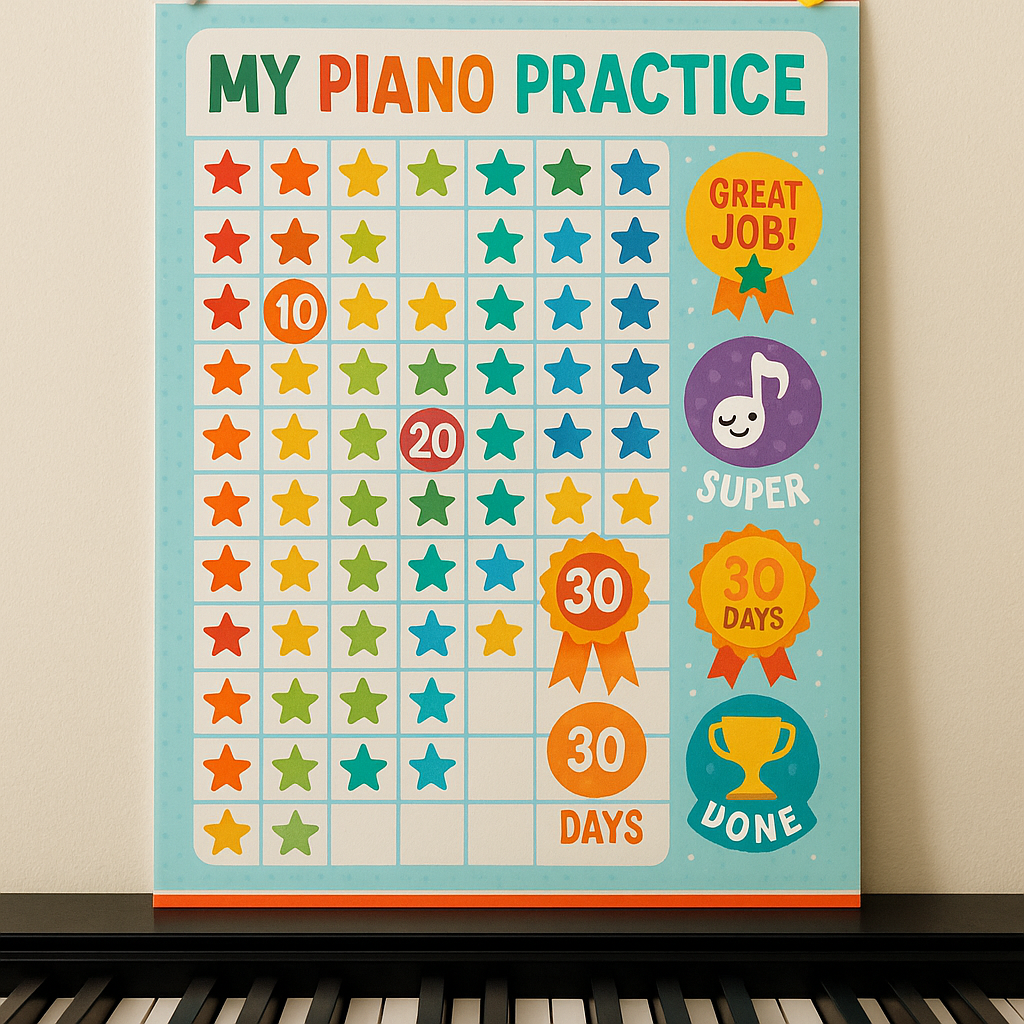
Transform your child's piano practice routine with a motivating reward chart that builds consistency, celebrates progress, and nurtures a lifelong love of music.
Why Reward Charts Build Musical Success and Confidence
Establishing a consistent piano practice routine can be one of the most challenging aspects of music education for young learners. Children naturally respond to positive reinforcement, and reward charts provide a visual, tangible way to acknowledge their efforts and progress. When implemented thoughtfully, these charts transform practice from a daily struggle into an engaging journey of achievement that builds both musical skills and self-confidence.
Research in child development and educational psychology demonstrates that visual progress tracking significantly enhances motivation and attention span in music lessons. For parents of kids taking private piano lessons, a well-designed reward chart serves as a powerful tool for keeping children motivated to practice piano while fostering independence and accountability. The chart creates a clear connection between effort and recognition, helping young musicians understand that consistent practice leads to measurable improvement.
Beyond the immediate benefit of increased practice time, reward charts teach children essential life skills including goal-setting, self-monitoring, and delayed gratification. These age-appropriate repertoire tools help students develop a growth mindset, understanding that musical proficiency comes through dedicated effort rather than innate talent alone. When children see their accumulated practice sessions represented visually, they gain a sense of ownership over their musical development that extends far beyond the piano bench.
The psychological impact of celebrating small wins cannot be overstated. Each sticker, checkmark, or star on a practice chart releases positive emotions that strengthen the neural pathways associated with piano practice. This positive association is crucial for kids piano lesson engagement, as it helps counteract the natural frustration that comes with learning challenging new skills. Over time, the external motivation provided by the chart helps cultivate intrinsic motivation, where children begin to practice because they genuinely enjoy the process and take pride in their progress.
Essential Elements Every Effective Piano Practice Chart Needs
An effective piano practice reward chart must balance structure with flexibility, providing clear expectations while remaining adaptable to your child's individual needs and developmental stage. The foundation of any successful chart includes specific, measurable practice goals that are appropriate for your child's age and skill level. Rather than vague objectives like 'practice piano today,' effective charts specify concrete targets such as 'practice for 15 minutes' or 'play the C major scale three times without mistakes.' This specificity helps children understand exactly what is expected and provides clear criteria for earning rewards.
Visual appeal is a critical component that directly impacts kids piano lesson engagement. The chart should be colorful, age-appropriate, and positioned in a prominent location where your child will see it daily. Consider incorporating your child's interests into the design—whether that means featuring their favorite colors, characters, or themes. The tracking mechanism should be immediately understandable at a glance, using stickers, stamps, checkmarks, or colored markers that children can apply themselves whenever possible. This hands-on participation increases investment in the process and provides immediate gratification after each practice session.
Successful practice charts also include a clear reward structure with multiple milestone levels. Rather than requiring weeks of practice before any recognition, effective charts offer short-term rewards that maintain momentum and attention span in music lessons. This might include small daily acknowledgments, medium-term weekly rewards, and larger monthly or completion bonuses. The chart should display this reward pathway clearly, allowing children to visualize how close they are to each achievement level. This tiered approach accommodates the developmental needs of young learners who benefit from frequent positive reinforcement.
Finally, an effective chart incorporates space for parental involvement and positive feedback. Include a section for brief encouraging notes, teacher comments from private lessons, or specific accomplishments beyond just time spent practicing. This element of practice routine and parental involvement transforms the chart from a simple tracking tool into a communication device that connects parents, students, and instructors. It also provides an opportunity to acknowledge qualitative improvements like better posture, increased focus, or mastering a particularly challenging passage, reinforcing that musical development encompasses more than just minutes at the keyboard.
Step-by-Step Guide to Creating Your Custom Reward Chart
Creating a personalized piano practice reward chart begins with a collaborative conversation with your child. Sit down together and discuss their current practice challenges, musical goals, and what types of rewards would be most meaningful to them. This partnership approach increases buy-in and ensures the chart addresses your child's specific needs rather than imposing a one-size-fits-all solution. Ask your child how many minutes they think they can realistically practice each day, and work together to set achievable starting goals that can be gradually increased as consistency improves. This conversation also provides an opportunity to emphasize that the chart's purpose is to celebrate progress and build skills, not to punish missed practice sessions.
Once you have established goals together, select a format that works for your family's lifestyle and your child's preferences. You can create a physical poster board chart using craft supplies, print a template from online resources, or use a digital tracking app that children can update on a tablet. For physical charts, gather colorful poster board, markers, stickers, and any decorative elements that will make the chart engaging. Create a grid or calendar format with clearly labeled days of the week, spaces to record practice time or completed tasks, and designated areas to display accumulated rewards. Consider laminating the chart or using a dry-erase surface if you want to reuse it for multiple months.
Next, establish the specific practice requirements and tracking method that align with fun piano teaching methods for kids. For younger children (ages 4-7), focus on time-based goals such as '10 minutes of practice' and use simple visual tracking like placing one sticker per completed session. For older elementary students (ages 8-11), consider task-based tracking that includes specific objectives like 'play assigned piece three times' or 'practice right hand separately.' Middle school students may benefit from more sophisticated tracking that includes quality indicators, self-assessment ratings, or specific technical goals. Whatever method you choose, ensure it is age-appropriate repertoire and matches your child's developmental stage and attention span.
Finally, define the reward structure by listing small, medium, and large incentives at different milestone points. Be specific about what is earned and when—for example, 'After 5 practice sessions, choose a special dessert; after 20 sessions, plan a fun family outing; after completing the month, select a new piece of music or small gift.' Write these rewards directly on the chart so they are always visible and motivating. Review the completed chart with your child, make any final adjustments based on their feedback, and establish a prominent display location. Consider creating a simple ceremony to 'launch' the new chart, perhaps taking a photo together or having your child's piano teacher sign it during the next lesson, which reinforces the importance of this new commitment to consistent practice.
Choosing Meaningful Rewards That Inspire Consistent Practice
The most effective rewards for keeping children motivated to practice piano are those that feel personally meaningful rather than generically valuable. Take time to understand what truly excites and motivates your individual child, as reward preferences vary significantly based on personality, interests, and developmental stage. For some children, experiences and privileges—such as extra screen time, a special outing, or choosing the family movie—provide greater motivation than material items. For others, tangible rewards like small toys, books, art supplies, or music-related items create the strongest incentive. The key is ensuring the rewards are proportionate to the effort required and genuinely valued by your child.
Consider incorporating music-related rewards that reinforce musical development and demonstrate that piano is a source of joy rather than obligation. These might include attending a live concert or musical performance, choosing a new piece of music to learn, recording a performance video to share with family, or earning one-on-one time with their piano teacher for a special lesson on a topic of their choice. You might also reward consistent practice with the opportunity to explore other musical activities, such as trying a different instrument for a day, composing their own short piece, or learning a favorite popular song outside their regular curriculum. These music-centered rewards strengthen the connection between effort and enjoyment while expanding musical horizons.
Structure your reward system to include both immediate and delayed gratification, accommodating the attention span in music lessons for different age groups. Young children benefit from daily or near-daily small rewards that provide frequent positive reinforcement—these might be as simple as choosing a special sticker, earning a small treat, or receiving an enthusiastic celebration from parents. Weekly rewards can be slightly more substantial, such as a favorite meal, extended playtime, or a small purchase. Monthly or program-completion rewards should be more significant—perhaps a special trip, a larger gift, or a celebration that acknowledges the sustained commitment required to reach this milestone.
Remember that non-material rewards and intrinsic motivators become increasingly important as children mature in their musical journey. Praise, recognition, and opportunities to demonstrate competence can be profoundly motivating, particularly when they come from respected figures like parents, teachers, or older siblings. Consider rewards such as performing for family members, recording progress videos to document improvement, earning the privilege to help teach a younger sibling, or receiving a certificate of achievement signed by their piano teacher. These recognition-based rewards help transition children from external motivation to internal satisfaction, supporting the development of lifelong musical engagement and practice routine and parental involvement that extends beyond childhood.
Tracking Progress and Celebrating Musical Milestones
Effective progress tracking extends beyond simply recording completed practice sessions to documenting the musical growth that results from consistent effort. Create opportunities within your reward chart system to note specific accomplishments such as mastering a challenging passage, performing a piece at tempo for the first time, or successfully completing a new scale or technical exercise. This qualitative tracking helps children understand that the purpose of practice is not merely to accumulate time but to develop genuine musical competence. When children can look back and see concrete evidence of skills they have acquired, it reinforces the value of persistent effort and builds confidence in their ability to overcome challenges.
Regular check-ins provide essential opportunities for reflection, adjustment, and celebration. Establish a weekly review routine where you and your child examine the practice chart together, discuss what went well, identify any obstacles that prevented practice, and problem-solve strategies for the coming week. This routine demonstrates practice routine and parental involvement while teaching children to self-reflect on their habits and progress. During these check-ins, ask open-ended questions like 'What was the most challenging part of your practice this week?' or 'What piece are you most proud of right now?' These conversations provide valuable insight into your child's musical experience and create opportunities to offer encouragement and support.
Milestone celebrations should be meaningful events that acknowledge the sustained effort required to reach significant goals. When your child completes a reward chart cycle—whether that is a month, a season, or a set number of practice sessions—create a special celebration that recognizes this achievement. This might include a family performance where your child plays their favorite pieces, a certificate ceremony, taking photos with the completed chart, or sharing the accomplishment with extended family members. Consider involving the piano teacher in these celebrations by having them provide a progress report, special recognition during lessons, or a certificate acknowledging the achievement. These celebrations create positive memories associated with musical accomplishment and reinforce the importance of dedication and perseverance.
As children develop consistency and musical skills through the reward chart system, gradually transition the focus from external rewards to intrinsic motivation and musical enjoyment. Help children recognize and articulate the internal satisfactions that come from musical progress—the pleasure of playing a favorite piece fluently, the pride of overcoming a technical challenge, or the joy of creative expression through music. You might adjust the reward structure over time to emphasize these intrinsic rewards, such as earning the privilege to choose their own repertoire, explore different musical styles, or have input into lesson structure and age-appropriate repertoire decisions. This gradual shift helps ensure that the reward chart serves as a bridge to genuine musical engagement rather than creating dependency on external incentives, ultimately fostering the self-motivated practice habits that support lifelong musical participation.